
Implementation and adoption
We maximise time-to-market and time-to-value with a holistic and comprehensive implementation and adoption methodology. It guarantees the success of the initiative, together with a flexible, transparent and scalable licensing model, while offering several alternatives for technical implementation.
Implementation approach
Implementation is not limited to installing technology. We operationalise the governance model and deliver a first use case in production with measurable metrics.
Initial assessment of architecture and infrastructure
Inventory of data platforms, networks, security, identities, and dependencies.
Initial assessment of architecture and infrastructure
1
Provisioning of environments and infrastructure
Preparation of environments (development, pre-production, production) and associated resources.
Provisioning of environments and infrastructure
2
Deployment of Anjana Data services
Installation of core components and health verification.
Deployment of Anjana Data services
3
Definition of the use case and success metrics
Selection of business case, KPIs, and target data sources.
Definition of the use case and success metrics
4
Technical configuration of connections and permissions
Integrations with IAM, technical catalogues, data platforms, and key systems.
Technical configuration of connections and permissions
5
6
Functional configuration of the platform
Functional configuration of the platform
Metamodel, domains, roles, approval flows, notifications, and templates.
7
Training and workshops
Training and workshops
Training by profile (administration, platform, user) and knowledge transfer.
8
Execution of the use case and drawing conclusions
Execution of the use case and drawing conclusions
Production launch, monitoring, lessons learned, and scaling plan.
9
Licence activation
Licence activation
Initial sizing, registration on the Customer Portal, and remote support.
Initial assessment of architecture and infrastructure
Inventory of data platforms, networks, security, identities, and dependencies.
1
Provisioning of environments and infrastructure
Preparation of environments (development, pre-production, production) and associated resources.
2
Deployment of Anjana Data services
Installation of core components and health verification.
3
Definition of the use case and success metrics
Selection of business case, KPIs, and target data sources.
4
Technical configuration of connections and permissions
Integrations with IAM, technical catalogues, data platforms, and key systems.
5
Functional configuration of the platform
Metamodel, domains, roles, approval flows, notifications, and templates.
6
Training and workshops
Training by profile (administration, platform, user) and knowledge transfer.
7
Execution of the use case and drawing conclusions
Production launch, monitoring, lessons learned, and scaling plan.
8
Licence activation
Initial sizing, registration on the Customer Portal, and remote support.
9
Key blocks of work
Expected outcome
Operational platform, governance model configured, first use case underway, and value KPIs established.
Use case and success metrics
Defining the scope, use case, and success metrics for implementation.
Service model and deployment type
Selection of service model and deployment type in accordance with internal policies.
Implementation plan
Detailed work plan with activities, responsible parties, dependencies, and milestones.
Technological landscape
Selection of technologies to consider and required integrations.
Different deployment and service modalities
-
Open, agnostic, and interoperable architecture to adapt to each organisation's internal policies.
-
Each deployment model includes all the mechanisms and tools to ensure security, scalability, automation, and monitoring.
-
The SaaS model also includes a comprehensive managed service.
On-premises (MV or k8s)
IaaS/PaaS (Hybrid or Cloud)
SaaS (Full or Hybrid)
Licensing model
Low initial investment and quick return on investment
We are committed to reducing the investment required for the initial implementation of a use case that allows value to be obtained in a short period of time.
Complete and reliable implementation for rapid adoption
Proprietary methodology that includes technical installation, integrations, functional configuration, practical workshops, and use cases.
Annual recurring licence with everything included
Different licence packages depending on usage, including all modules, updates, integrations, support, and training.
Incremental and iterative adoption approach
Scalability that allows the organisation to match investment with growth and evolution in its degree of maturity.
What exactly is being licensed?
The primary metric is the number of governed objects (in Approved or Deprecated status) within the Anjana Data Platform production instance. In the SaaS model A specific infrastructure configuration is also included in a private account.
The number of instances will depend on organisational or technological segregation requirements. A single instance Anjana Data Platform is sufficient to implement and operationalise governance models. multi-domain, multi-cluster and/or multi-environment.
Value-added services included
Edit Content
Customer Portal
Full access to:
Guides and documentation for User, Installation, Operation, Administration, and Configuration.
Documentation of technical architecture and platform technologies.
APIs and SDKs (reference and examples).
Specific information for partners
Notes from versions and updates.
Documentation of licences, prices, support, and professional services.
Restricted content: use cases, webinars, and white papers
Specific information for partners
Edit Content
Training Platform
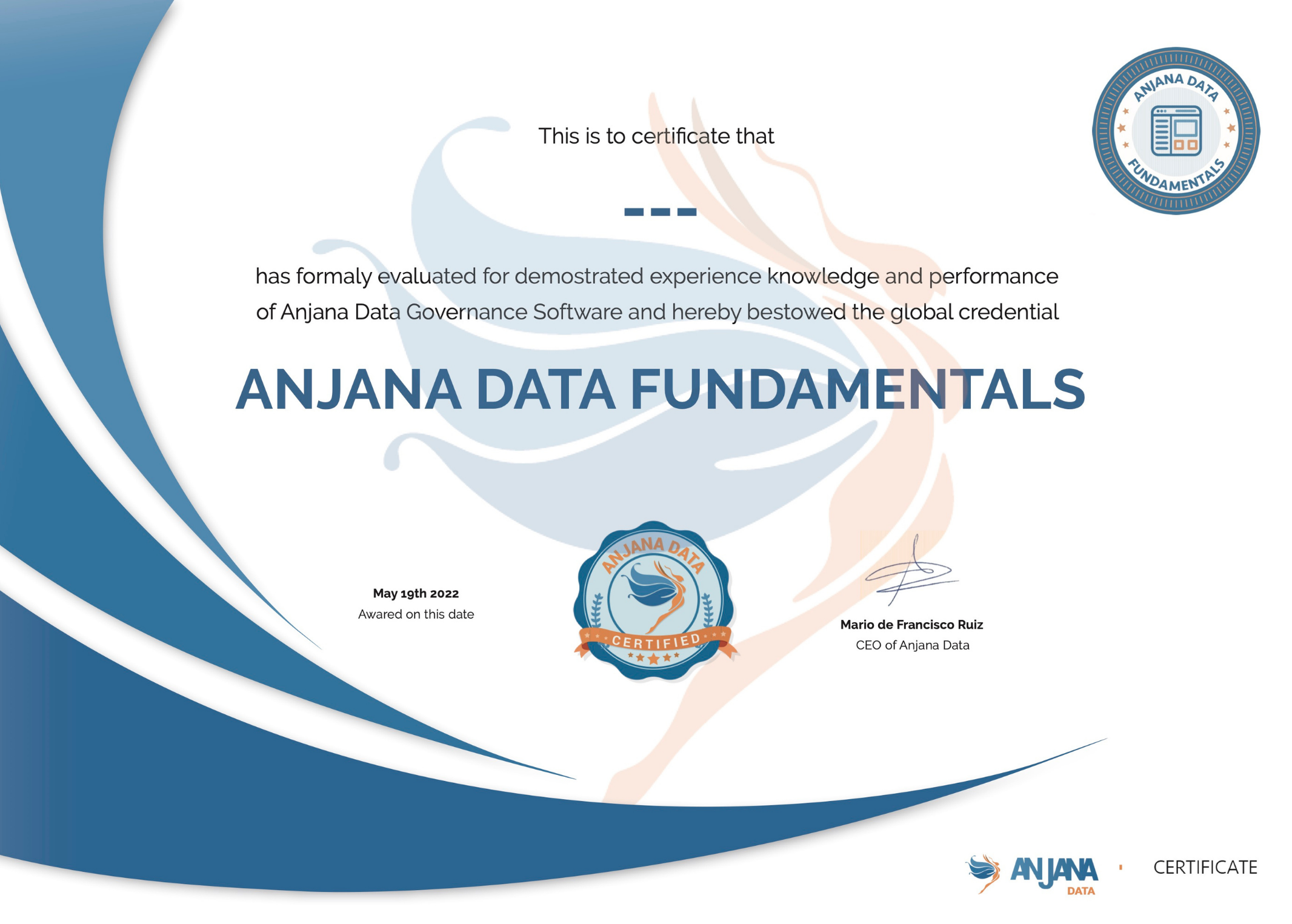
Official Certification from Anjana Data Platform with 4 modules:
-
User
-
Functional Administrator
-
Technical Administrator
-
Platform Administrator
Edit Content
Standard remote support:
-
Private customer area to manage and view the history of open and resolved tickets.
-
24/7 support with generative AI and access to all available resources.
-
8×5 human remote assistance during business hours in the country of operation.
-
TOR for ticket categorisation and TOA for initial response.
-
Ticket management by category and comprehensive service tracking.

Frequently Asked Questions
Frequently asked questions
Any dataset registered in the metamodel and subject to the governance lifecycle whose status is Approved o Deprecated.
No. Licensing does not penalise the growth of the data community.
By sections of governed objects. You can expand the section as your use cases evolve.
Yes. Licences include updates and access to release notes and roadmap.
Yes. The design is modular and allows for hybrid architectures.
Ready to take Data Governance & AI to the next level?
Don't wait any longer and discover how to make your organisation Data & AI Driven with Anjana Data Platform.