

Discover what active metadata is and why it is so important in a Data Fabric & Data Mesh ecosystem with Anjana Data.
I'm sure you've not long ago heard about the concepts of Data Mesh & Data Fabric, If not, we have no doubt that you will soon start to hear different opinions on this subject. For this reason, from Anjana Data, a few weeks ago, we started to prepare a series of resources from the hand of Gartner to highlight these two concepts within our community.
However, before closing this series of resources (which you can access through our website), we wanted to talk to you about a fundamental piece of any data strategy: the metadata. The first thing we are going to do is to explain what metadata is.
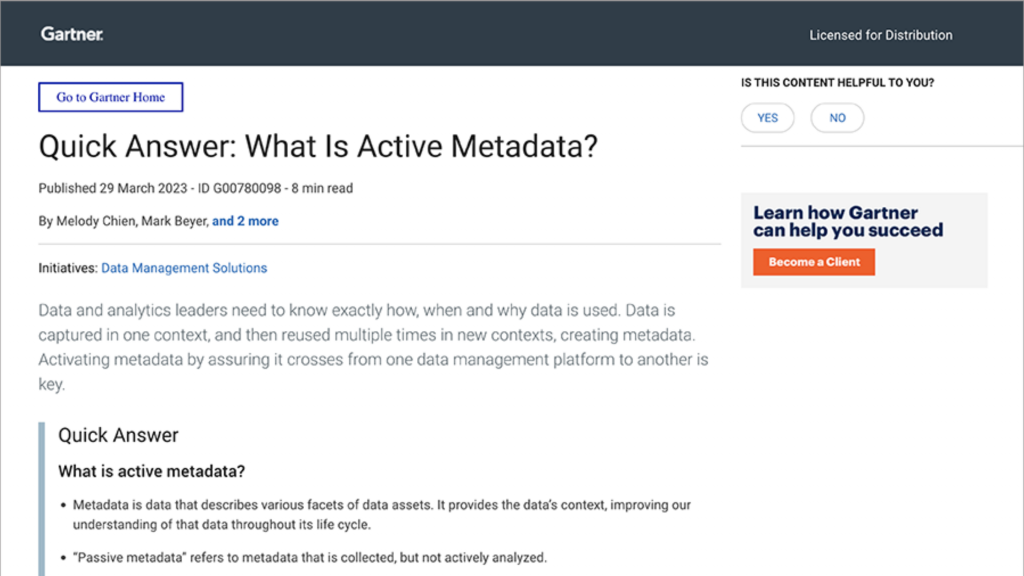
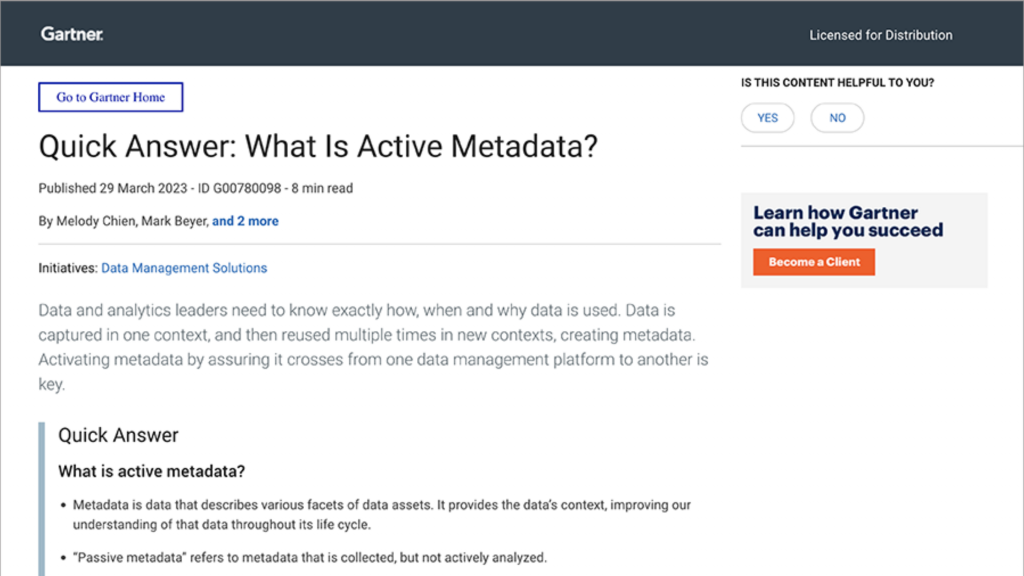
The metadata are data that describe various facets of data assets, providing the context necessary to use e interpreting and improving our understanding of these data throughout their lifecycle. We can speak of business, technical and operational metadata, Depending on the source of the data, we can also identify multiple uses for metadata. Data without metadata is arguably meaningless, which is why it is so important to manage it.
But beware, there are two types of metadata...
- On the one hand, the passive metadata refer to metadata that is collected but not actively analysed.
- On the other hand, the active metadata means metadata that identifies shared, distributed or dependent actions between two or more systems using the same or similar data to create an interactive processing network.
Metadata allows the automation in data channelling, provide knowledge about data characteristics and optimise user engagement. In addition, they are a key enabler Data Fabric, Data Mesh, microservices, Data as a Service (DaaS) and its continuous evolution.
At this point, in order to succeed in building an ecosystem Data Fabric & Data Mesh, In this context, we must emphasise the importance of a active management of metadata since the activation of metadata is the basis of these architectures. This can be seen in three complementary approaches:
- Provide the organisation with a common business language and a shared vision The aim is to turn data into a strategic asset that can be monetised. Enabling the metadata of a Data Catalogue, a Business Glossary and a Data Portal is key to achieving this goal and thus being able to create Data Products.
- Automate processes The construction of a centralised metadata repository with a flexible metamodel and the deployment of bi-directional native integrations with the different technologies of our data ecosystem serves this purpose. Building a centralised metadata repository with a flexible metamodel and deploying bi-directional native integrations with the different technologies of our data ecosystem serves this purpose.
- Enable a collaborative and governed space to extend this metadata management to all data stakeholders, so that they are all part of a federated ecosystem that also integrates different points of view to provide a holistic view of our data landscape.
How could it be otherwise?, Anjana Data complies by design with these premises, and this approach is part of our philosophy that has positioned us as a leader in the Data & Analytics Governance Platforms segment.
Anjana Data presents the Gartner document below. ‘Quick Answer: What Is Active Metadata?’, which addresses the concept of metadata and how it works.