
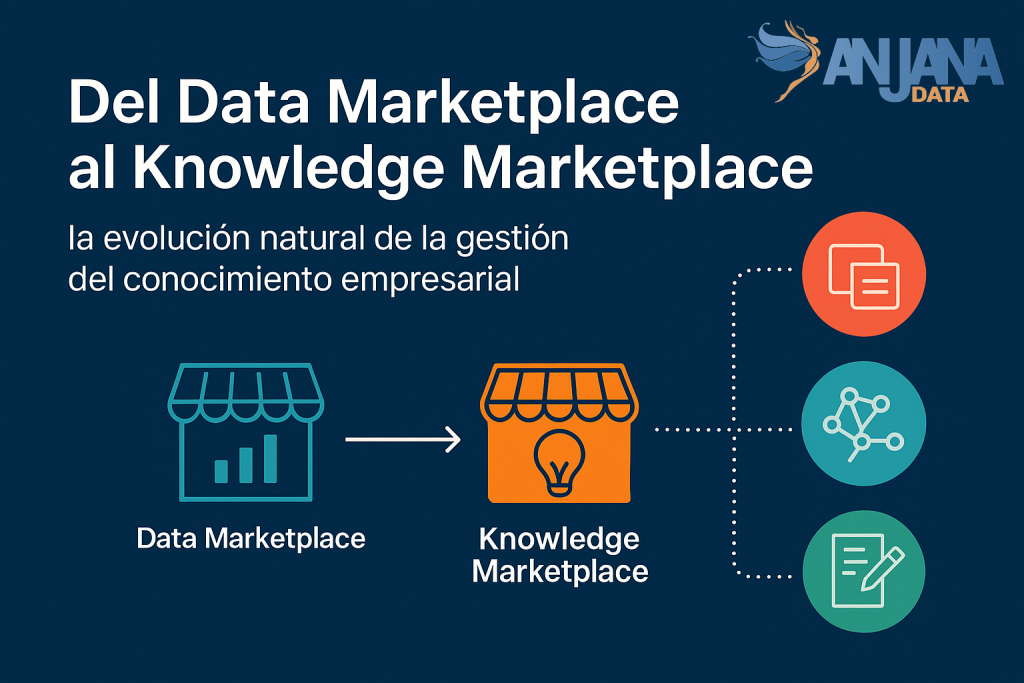
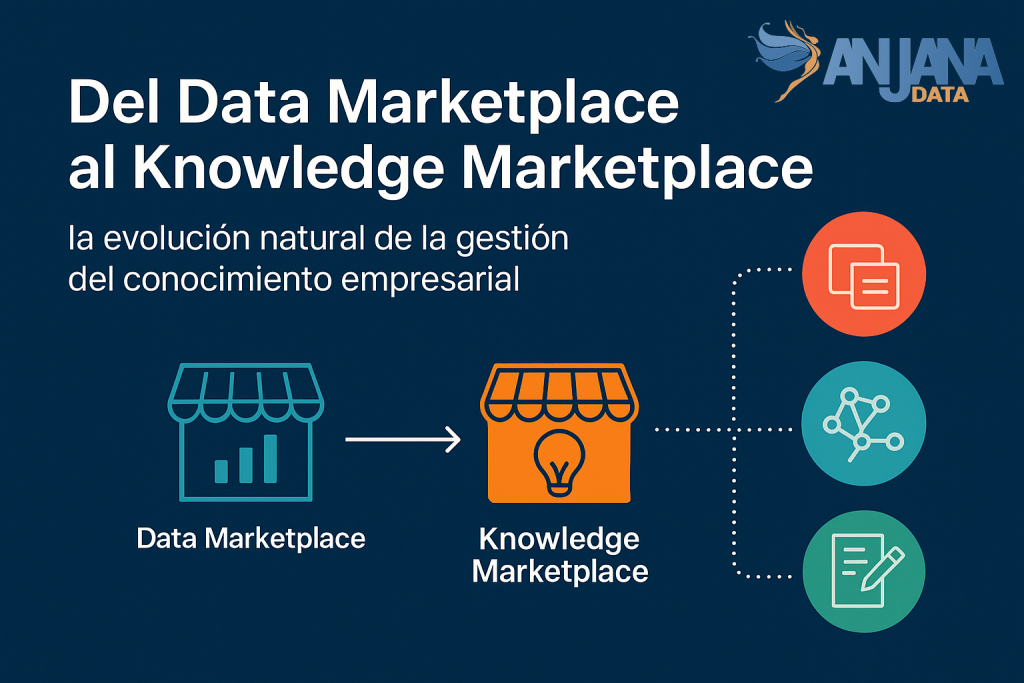
From Data Marketplace to Knowledge Marketplace: the natural evolution of enterprise knowledge management
📜 From Data Portals and Internal Catalogues to Intelligent Data Sharing
The current revolution around the data sharing, the data contracts, interoperability and Data Marketplaces has its roots in two key currents:
- Public Data Portals, born of the movement Open Data, oriented to the external sharing of datasets by governments and institutions. Tools such as CKAN, Socrata o OpenDataSoft and standards such as DCAT-AP were instrumental in establishing solid foundations for semantic and structural interoperability.
- Enterprise Data Catalogues, IT-driven, IT-driven and Data Governance, with a focus on internal data governance, discovery, traceability and quality.
From this merger, and driven by the consolidation of the e-commerce the Data Marketplacea hybrid environment for publishing and consuming data assets, both internally and externally, under a framework of control, security and collaboration.
🚀 Anjana Data: from visionaries of the Data Marketplace to builders of the Knowledge Marketplace
It has been almost 6 years, when he was born Anjana Data We were already talking about Data Portal, Shopping cart y Data Sharing Agreements (Link to the article), whose conjunction later became the now so famous concept of the Data Marketplace which we have started to implement in leading organisations such as the Banco Santander:
- Santander Group & Anjana Data: The journey towards data driven self-service
- Anjana Data and Santander Group offer the keys to achieving success in the Single Data Marketplace at the 2021 Data Management Summit
But in recent years (and almost without realising it) we have gone a step further by enabling organisations to build what we have called Knowledge Marketplace, where data becomes reusable, sharable, governed and actionable information and intelligence products.
🧠 What is a Knowledge Marketplace?
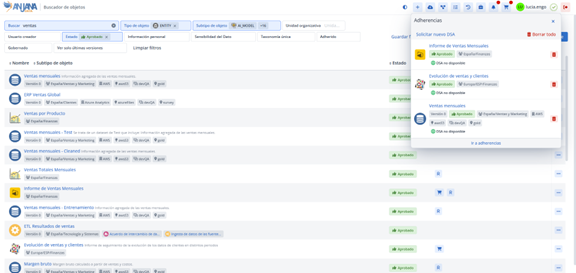
One Knowledge Marketplace is an evolution of the Data Marketplace, which makes it possible to manage not only datasets, but also:
- Information Products: reports, KPIs, dashboards, advanced analytics.
- AI products: models, algorithms, pipelines, reusable APIs.
- Enriched knowledge assetswith metadata, contracts, policies and context of use.
These products are designed and managed under a product thinking, where each asset has a purpose, a target audience, a responsible party and a defined life cycle.
⚙️ Flexibility, scalability, interoperability and usability - key requirements
One of the biggest challenges today is that organisations are operating in environments very diverse, heterogeneous and changing, The modern platform must be able to meet the needs of its users, both in terms of technology, culture and organisational maturity. A modern platform must therefore comply with four fundamental requirements:
🔧 1. Flexibility and no-code customisation
Anjana Data Platform is highly configurable and customisable, without the need for custom development. Thanks to its advanced parameterisation and no-code approach, The system adapts to the operating models, organisational structures and data domains of each organisation, without imposing closed or rigid models.
⚙️ 2. Technical and functional scalability
The platform is built on an architecture modular and scalable, The new system, which allows you to grow from a minimal deployment to a global, federated and distributed governance ecosystem, supporting multiple domains, organisations and territories.
🔌 3. Full interoperability and no black boxes
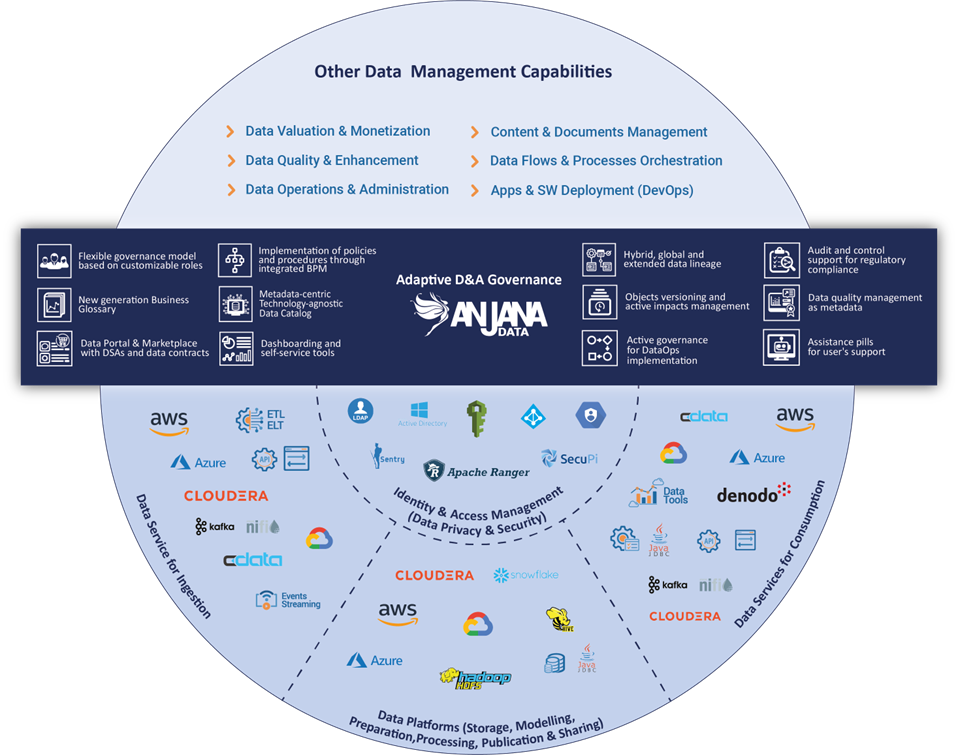
Anjana Data is completely apified and contains no «black boxes». All components are accessible via REST APIs and it has native bi-directional connectors to:
- Identity management systems (LDAP, SAML, OpenID, OAuth2...)
- Data management technologies (ETLs, Data Lakes, BI, catalogues, MDMs...)
- Main Cloud providers (Azure, AWS, Google Cloud...)
This guarantees its seamless integration into the existing technology ecosystem, without lock-in and dependencies.
🧑💼 4. User experience for non-technical profiles
In an environment where information and knowledge must be democratised, it is essential that the platform is not only designed for expert users or technical profiles.
Anjana Data Platform offers a intuitive interface, with a reduced learning curve, designed for:
- Facilitating self-service data, information and AI.
- Enable business users to discover, request and consume knowledge products without friction.
- Encourage mass adoption of data governance throughout the organisation.
This user-centred approach allows the value of knowledge is not confined to specialised areas, but flow with context and utility to all business units.
🧬 Metadata Lake & Active Metadata: the intelligent heart of the Knowledge Marketplace
In a modern data ecosystem, the real value is not just in the data, but in the context of the data.The following information is available: origin, use, quality, responsible parties, relations, legal conditions and policies. In other words, in the metadata.
But metadata can no longer be static or disconnected. To scale a Knowledge Marketplace, we need a Metadata Lake with the capacity to Active Metadata.
What is a Metadata Lake?
It is a centralised and governed repository that integrates all technical, business, operational, legal and organisational metadata in a structured, dynamic and enriched way, and makes it available to all systems and users.
⚡ What is Active Metadata?
The Active Metadata converts this metadata into live and operational elements, which:
- They trigger automatic flows and governance policies.
- They feed recommendation engines and contextual rules.
- They allow synchronisation with other tools in real time.
- They enable business decisions based on contextualised knowledge.
🧩 How does it materialise in the Anjana Data Platform?
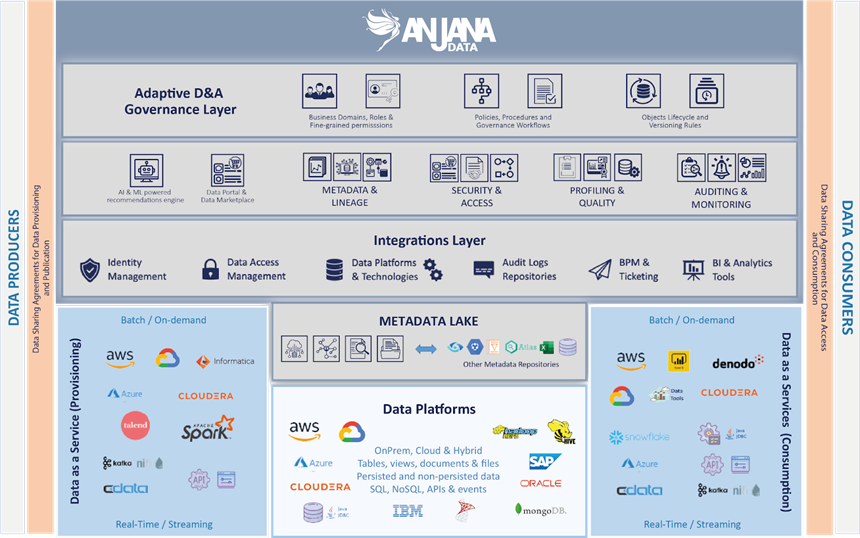
Anjana Data Platform allows you to leverage all of its governance capabilities by building a Metadata Lake with the capacity to Active Metadata, al:
- Offer a customisable and extensible semantic metamodel, based on typed entities and relationships.
- Organise information assets by domains.
- Support a multitude of metadata attributes of different types, from the simplest to the most complex.
- Enable full lifecycle management of information assets and their different versions.
- Integrate a configurable event and policy system.
- Expose everything through open APIs and bi-directional connectors.
- Convert the metadata in the operational axis of governance and knowledge sharing.
🤝 Data Sharing Agreements and Data Contracts: clear rules of the game
In order for a Knowledge Marketplace scalable, secure and reliable operation, there is a need to establish explicit and automated sharing and governance frameworks. In this sense, Anjana Data Platform incorporates natively:
- Data Sharing Agreementsagreements between domains or external parties on terms of use, frequency, security, privacy, licensing, etc.
- Data Contractstechnical and business compromises between producers and consumers on the content, structure, quality, availability and maintenance of products.
These elements are fundamental to building trust and enabling sustainable knowledge-sharing models, interoperable and traceable, as promoted by initiatives such as IDSA, Gaia-X and the Data Governance Act.
If you want to learn more about these concepts, here are some additional resources:
- Data Sharing Agreements and governed data self-service
- How to successfully build an internal Data Marketplace for your organisation
- Factsheet: Data Sharing Agreements
🛡️ Proactive and preventive government vs. passive and reactive government
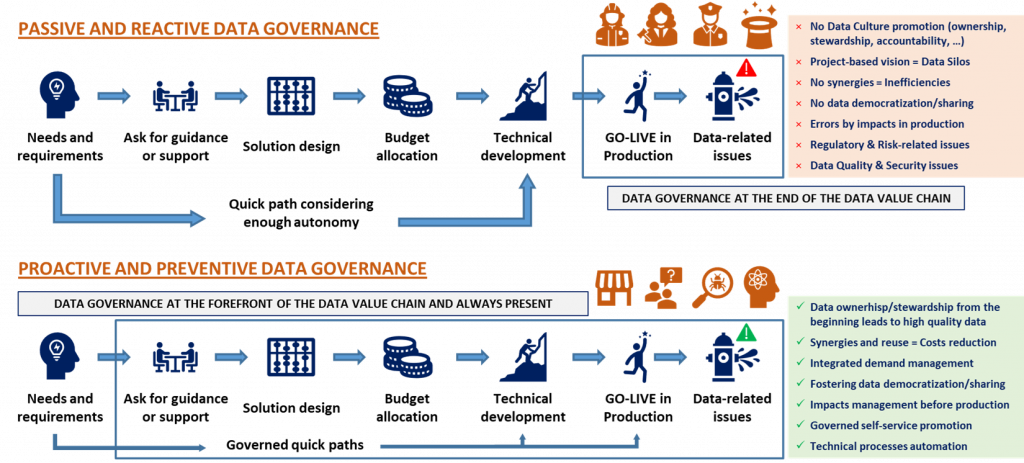
In many traditional approaches to Data Governance, In the case of the EU, policies are implemented late, when the problems have already occurred. Anjana Data is committed to a proactive and preventative model, in which:
- The government is integrates from the design of the knowledge product.
- It is validated ex ante compliance with policies, rather than just ex-post auditing.
- It connects directly to the demand management and daily operations, The new system, allowing the processes of access, use and re-use to be governed from the outset.
This approach facilitates the operationalisation of government, making it visible, measurable, and actionable, which is key to scaling a Knowledge Marketplace real.
If you would like to know a little more about the differences between these approaches, we suggest you take a look at this paper of our CEO Mario de Francisco.
🧩 Perfect fit with modern architectures
Anjana Data is aligned with the main emerging architectures:
- Data FabricAccess orchestration and governance over distributed data.
- Data Mesh: enabling responsible domains with federated governance.
- Data Spacessemantic, organisational, technical and legal interoperability between organisations.
All this, with metadata compatible with DCAT-AP, facilitating the exchange of catalogues and resources with European public and private platforms.
In this context, we have joint value propositions with the following vendors, offering native integrations with several of the technology pieces that they incorporate in their suites or platforms:
- Amazon Web Services
- Microsoft Azure
- Google Cloud Platform
- Denodo
- Cloudera
- Oracle
- SQL Server
- Snowflake
- Databricks
- Teradata
For each of these joint value propositions, there are also different approaches, depending on the capabilities to be covered or the final architecture to be built. Moreover, these value propositions are combinable, so that the resulting final architecture for a customer can be the combination of different joint value propositions, covering different capabilities depending on the technologies to be considered.
To take an example taken to the extreme, we could be considering a hybrid multi-cloud architecture with native AWS, Azure and GCP pieces, traditional DWH with Oracle, SQL Server or Teradata, an on-premise Datalake with Cloudera, a Big Data Platform in the Cloud with Snowflake or Databricks, a virtualisation layer with Denodo and all governed by Anjana Data Platform with the corresponding native integrations to cover the desired capabilities.
Thanks to this approach, the Knowledge Marketplace will always remain agnostic to the underlying technology architecture but we will be able to take advantage of all the native capabilities that support governance and are offered out of the box by the different pieces of that architecture (such as catalogues, metadata management, security, auditing, ...) and then integrate them into the higher level governance layer that will always remain in the Anjana Data Platform.
You can find an example of such complex architectures at this resource which we publish together with our partner Denodo.
📜 Regulatory compliance and alignment
The platform is designed in compliance with the main regulatory frameworks and international standards:
- Data Governance Act & Data Act
- DAMA-DMBOK2 (Special appeal)
- UNE 0077, 0078, 0079
- Gaia-X & IDSA
- DCAT-AP (interoperable semantics)
- AI Act (Special appeal)
- GDPR and Data Protection Laws (Special appeal)
This makes it possible to operate in both closed environments and open ecosystems with guarantees of sovereignty, ethics and legality.
📈 A view endorsed by analysts and adopted by industry leaders
The evolution towards a Knowledge Marketplace is not just an emerging trend, but a reality backed by analysts and embraced by leading suppliers and organisations:
🔍 Analyst perspectives
- Gartner, in its report Hype Cycle for Data Management 2024, The report highlights the growing importance of the AI Data Marketplaces as key catalysts for data-driven innovation and advanced AI governance. .
- Forrester, in its report Data Governance Market Trends 2024, The report stresses that data governance is essential to power AI-driven applications, addressing challenges such as data silos and low data literacy. .
- BARC, in its Data, BI & Analytics Trend Monitor 2024, The report identifies data governance and data literacy as key trends for data-driven organisations. .
- IDC, in his study Worldwide Data Modernization Services 2024, The report evaluates providers in the data modernisation services market, highlighting the need for platforms that facilitate digital transformation and modernisation of data management. .
Adoption by leading vendors and alignment with modern architectures
The vision of Knowledge Marketplace as the backbone of data governance and knowledge management is perfectly aligned with the technology strategies promoted by leading cloud service and data platform providers.
Anjana Data Platform fits naturally into the environments of AWS, Microsoft Azure and Google Cloud Platform (GCP), thanks to its modular, fully unified, agnostic and scalable architecture. This integration is materialised through:
- Bi-directional native connectors that facilitate interaction with the identity, storage, processing and catalogue services offered by these hyperscalers.
- Full interoperability with multi-cloud and hybrid ecosystems, favouring environments where different technologies and distributed data architectures coexist.
- Government decoupled from infrastructure, This enables organisations to maintain control and traceability of their knowledge assets no matter where they reside or by what technology they are managed.
Our proposal also complements and powers platforms such as Snowflake, Databricks, Cloudera, Denodo and other widely adopted data technologies., The new system provides a unifying layer of governance, active metadata, contract management and business-driven user experience, enabling a true cross-platform view.
This approach places Anjana Data Platform as a solution agnostic, integrative and ready to operate in domain-oriented architectures, where data, AI products and information flow in a governed manner between services, clouds, technologies and users, meeting the highest standards of interoperability, scalability and digital sovereignty.
🌟 Pioneering customers adopting our vision
Our vision of a Knowledge Marketplace has been adopted by leading customers in a variety of industries who have transformed their data strategies to drive innovation and operational efficiency. These customers have successfully implemented Anjana Data Platform, highlighting:
- The ability to integrate data governance into operational flows, promoting a proactive and preventive approach.
- Ease of use for non-technical profiles, thanks to an intuitive interface and a reduced learning curve.
- Full interoperability with existing systems, facilitating frictionless integration into diverse technology ecosystems.
These success stories reflect how Anjana Data Platform not only anticipated the evolution towards a Knowledge Marketplace, It has materialised it, providing organisations with a living, governed and interoperable platform to transform their data strategy.
🎥 See it in action
👉 Demo: Knowledge Marketplace with Anjana Data Platform 25.1
🧭 Conclusion
The future of data is not about collecting assets, but about transform them into operational and shared knowledge.
This requires a living, governed, interoperable platform designed to scale.
Anjana Data not only anticipated this vision: has made it a reality.
With modular architecture, embedded governance, active metadata, contracts, automation, product focus, and user experience, it enables organisations to build your own Knowledge Marketplace new generation.
Are you ready to transform your data strategy?