
Approach, Architecture, and Pricing: the three distinguishing pillars of Anjana Data

The Data Governance solution for the era of Big Data and Multi-Cloud with three distinctive pillars from Anjana Data: approach, architecture, and pricing.
Anjana Data is constantly evolving, developing an innovative and disruptive solution that aims to help organisations turn data into a strategic asset of great value to the business, implementing a collaborative model focused on unified metadata management and involving different roles with their functions, rights and responsibilities, from business areas to IT departments, including cross-functional teams.
The new technological era has created the need to implement a governance framework that promotes the democratisation of data and the implementation of a data culture in organisations. This requires the development of a holistic solution adapted to these new technological paradigms in companies, offering differentiation and advances in its use aimed at generating value for the business.
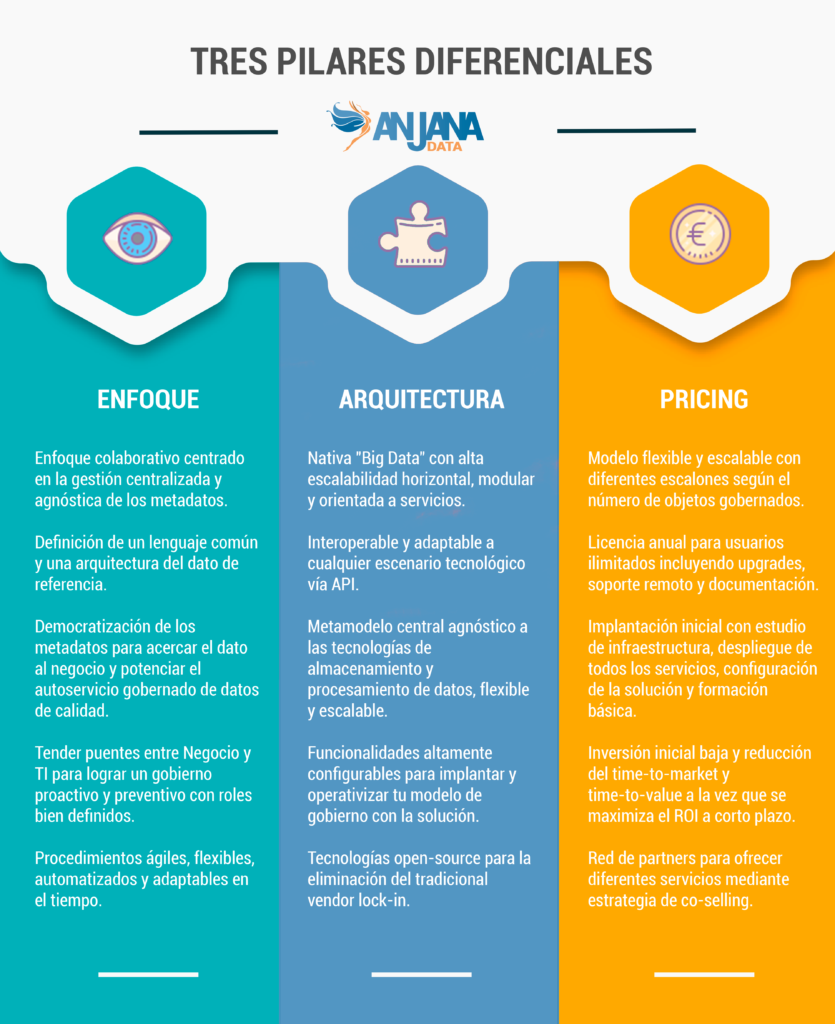
So, What makes Anjana Data?. We mention below the 3 distinguishing pillars of our solution:
- Focus: Our vision of data governance as a collaborative approach focused on metadata.
- Architecture: Native Big Data, modular and service-oriented, using consolidated open-source technologies, which provides significant advantages over more traditional solutions (scalability, interoperability, adaptability, flexibility, etc.).
- Pricing and licensing model: No user limits, scalable and flexible, also attempting to break vendor lock-in.
Anjana Data's collaborative and interactive approach
As for our government vision, The idea behind using Anjana Data is to assist the Organisation. in the implementation of proactive and preventive data governance This will enable centralised management of metadata using a single, common language, allowing us to control the impact of changes, access to information, etc. Furthermore, using Anjana Data as a «single source of truth for governance» will enable us to detect ungoverned processes, datasets with incorrectly declared metadata, unauthorised access, etc. occurring in controlled environments.
Within this approach, Anjana aims to build bridges between Business and IT, bringing data closer to decision-making and enhancing the Governed self-service of quality data. To this end, Anjana Data proposes promoting a data culture extended throughout the organisation with the implementation of Agile, flexible procedures adapted over time.
That said, our goal with Anjana Data is to provide the possibility of automate all technical processes as much as possible underlying data governance, for which Anjana Data has 4 types of integration with different platforms/systems/databases/technologies data storage, processing and exploitation:
- Extraction of declarative metadata (business, technical, and operational): Ability to extract metadata from databases and upload it to Anjana Data as datasets.«
- Static lineage (relationships between objects): Ability to interpret processes and executions at rest (ETL, engines, scripts, etc.) and load them into Anjana Data as «processes» and «instances».
- Active government:
- Permission management: Ability to automate the generation of permissions (ACLs, grants, etc., at user/group level).
- Modification of data structures: Ability to automate the creation, modification, and deletion of data structures (e.g., tables).
- Dynamic lineage (audit metadata): Ability to retrieve and interpret platform audit logs to find out which processes have been executed, which user launched them, when they started and ended, and which datasets were involved (e.g., tables read and written by the process). We can then cross-reference this information with the objects governed by Anjana Data (datasets and processes) to obtain a history of what has been executed for each one and also to detect items that are not governed and therefore cannot be cross-referenced (ungoverned processes/datasets, metadata inconsistencies, unauthorised access, etc.).
Modular, service-oriented architecture
Anjana Data's architecture has a central metamodel agnostic to data storage and processing technologies, flexible and scalable, is interoperable and adaptable to any technological scenario. Its functionalities are highly configurable to easily implement and operationalise the solution with the governance model implemented in the business.
Anjana Data as a technological solution is defined by the following characteristics aligned with its components: open-source pointers and consolidated:
- Configuration and flexibility Most of Anjana Data's capabilities and functionalities can be configured from an administration front end to adapt the solution to the defined governance model and can also be modified over time.
- Interoperability through API >> We provide an API layer to interact with Anjana Data (internal repositories and functionalities) in both read and write modes, allowing integration into any technological scenario without the need for our involvement, as the entire API is documented (avoiding vendor lock-in).
- Native integration >> As part of our roadmap, we develop connectors and methods for native integration with different platforms and technologies, focusing primarily on Big Data and Cloud, which is where the greatest complexity lies and where we are highly differentiated. Some of these integrations are already in production, and we have partnerships with leading technology vendors.
Licensing and pricing model
In line with our philosophy and in an effort to adapt our business model to the latest trends, the Anjana Data licensing and pricing model is based on flexible and scalable pricing designed for clients of various sizes and sectors, whether they may have the initial need to implement data governance from scratch in their organisation or for those who already use other technologies and require integration to achieve effective governance. Our model is divided into two main parts:
- Initial implementation cost. With this, we want to offer our customers a comprehensive and reliable implementation, including infrastructure and architecture assessment, deployment of all services in production, configuration of the solution based on your governance model, and initial training for immediate use. This will reduce time-to-market and time-to-value.
- Flexible annual licence based on the number of governed objects. This part also includes all solution updates, basic remote support (via ticketing tool) and access to the Customer Portal (with all useful documentation available and visibility of the Roadmap).
This pricing model from Anjana Data also has several licensing levels depending on the number of objects to be governed. The tiers are designed to cover everything from companies with smaller data needs to large multinational corporations that need to proactively govern their data to extract value for the business. For this reason, Anjana Data adapts to the organisation's needs so that no large initial investment is required, allowing short/medium-term control of the resulting ROI at all times.
Would you like to see how these three pillars converge at Anjana Data? We'll show you a demo!