
Webinar Summary: The Importance of Data Governance in the DAMA Framework
LADY – the International Data Management Association – elected its first board of directors in 1988. The first chapter was founded in 1980 in Los Angeles. From that moment on, it became clear that the most urgent thing in an industry that was starting to take its first steps was to have a unique theoretical framework. A language that all professionals could understand and that would be a reference when dealing with any Data Management project.
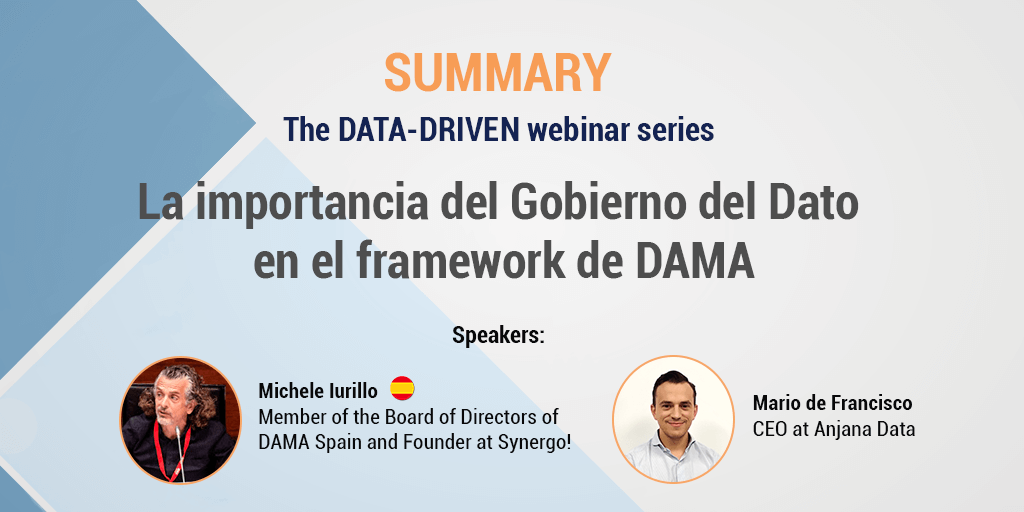
In this third webinar in the series «The DATA-DRIVEN webinar series» we had the pleasure of talking with Michele Iurillo, member of the board of directors of DAMA Spain and Founder of Synergo! who, together with Mario de Francisco, Chief Executive Officer of Anjana Data, resolved some queries regarding Data Management and the importance of Data Governance within the framework of DAMA.
But… What is Data Management really?
To quote DAMA, Data Management is: the development, execution, and monitoring of plans, policies, programmes, and practices that deliver, control, protect, and enhance the value of data and information assets throughout their life cycles. From its foundation in 1980 to 2020, many things have changed, there are new technologies, there are even companies that have among their assets almost exclusively data, but DAMA's methodology is still the best foundation for a professional who wants to focus his or her knowledge on information assets. DAMA defines Data Management as a set of 11 knowledge areas and, thanks to the DMBoK 2 reference, has created a framework of excellence and good practices that is a worldwide benchmark. A volume of more than 700 pages that DM professionals use and quote almost like the Bible. The DMBoK 2 has created a framework of excellence and good practice that is referenced worldwide. This methodology identifies Data Management in 11 Areas.
There are many frameworks, but DAMA resists technology and paradigm changes because it is oriented towards a more semantic and philosophical side of DM. If it is true that someone says that there are «poets» missing from Data Management, they surely have DMBok2 on their shelves.
Here are some important points from both presentations:
DAMA: A Framework for Data Management
- It is the data that allows us to move from the dimension of «how» to do things to the dimension of «what» makes sense to do, which is the real turning point of the Digital Transformation.
- Data Governance, what is data governance? «Data Governance is the exercise of decision-making and authority for data-related matters,» definition by the Data Governance Institute.
- If we follow DAMA's approach to Data Management, Data Governance is the central element. There is no Data Management without it.
-
- Data governance prepares us for the digital transformation process.
- Data governance helps us to make efficient decisions.
- Data governance enables us to improve processes.
- It maximises the revenue generation potential of data and leverages the lineage of data.
-
- The DAMA methodology defines Data Management as a set of 11 knowledge areas and, thanks to the DMBoK2 reference, has created a framework of excellence and good practices that is a worldwide benchmark.
-
- It is not possible to have adequate control of data and transform it into reliable information without addressing the DM in its entirety.
- Data Governance
- Data architecture
- Modellisation et conception des données
- Data storage and operations
- Security, integration, and management of documents and content.
- Data Security
Integración de datos e interoperabilidad - Document and content management
- Data Security
- DW & BI, Master data, metadata and quality.
- Reference and master data
- Data warehousing and Business Intelligence
- Metadata
- Data quality
- It is not possible to have adequate control of data and transform it into reliable information without addressing the DM in its entirety.
-
- Data governance begins with the data management infrastructure. We will be able to establish a governance model as long as we have chosen an infrastructure geared towards it:
-
-
- Descentralised organisation
- Organisational Network
- Centralised organisation
- Hybrid Organisation
- Federated Organisation
-
-

Data governance in the DAMA framework
According to the DMBoK2:
-
- Data governance is defined as the exercise of authority and control (planning, monitoring, and enforcement) over the management of data assets.
- The data governance function guides all other data management functions.
The purpose of data governance is to ensure that data is managed correctly, according to defined policies and best practices. - Data Governance vs. Data Management = Oversight vs. Execution
- Data governance requires planning, not only to represent organisational change but also simply because it involves many complex activities that need to be coordinated.
- A scalable and interactive implementation based on limited use cases maximises the chances of success and reduces potential frustration in the teams involved.
And something also VERY IMPORTANT: The technology of being an enabler and accelerator for data governance but not solving the basic needs by itself, needs strategy, people and processes.
If you would like to know more about how Anjana Data can help you in your data strategy by changing the vision of data governance in your organisation, request a demonstration.
You can watch the complete webinar The importance of Data Governance in the DAMA framework video on our YouTube channel, where you will also find more videos related to Data Governance. You can subscribe to receive notifications of new videos.